by Flinn Inspections
Share
by Flinn Inspections
Share
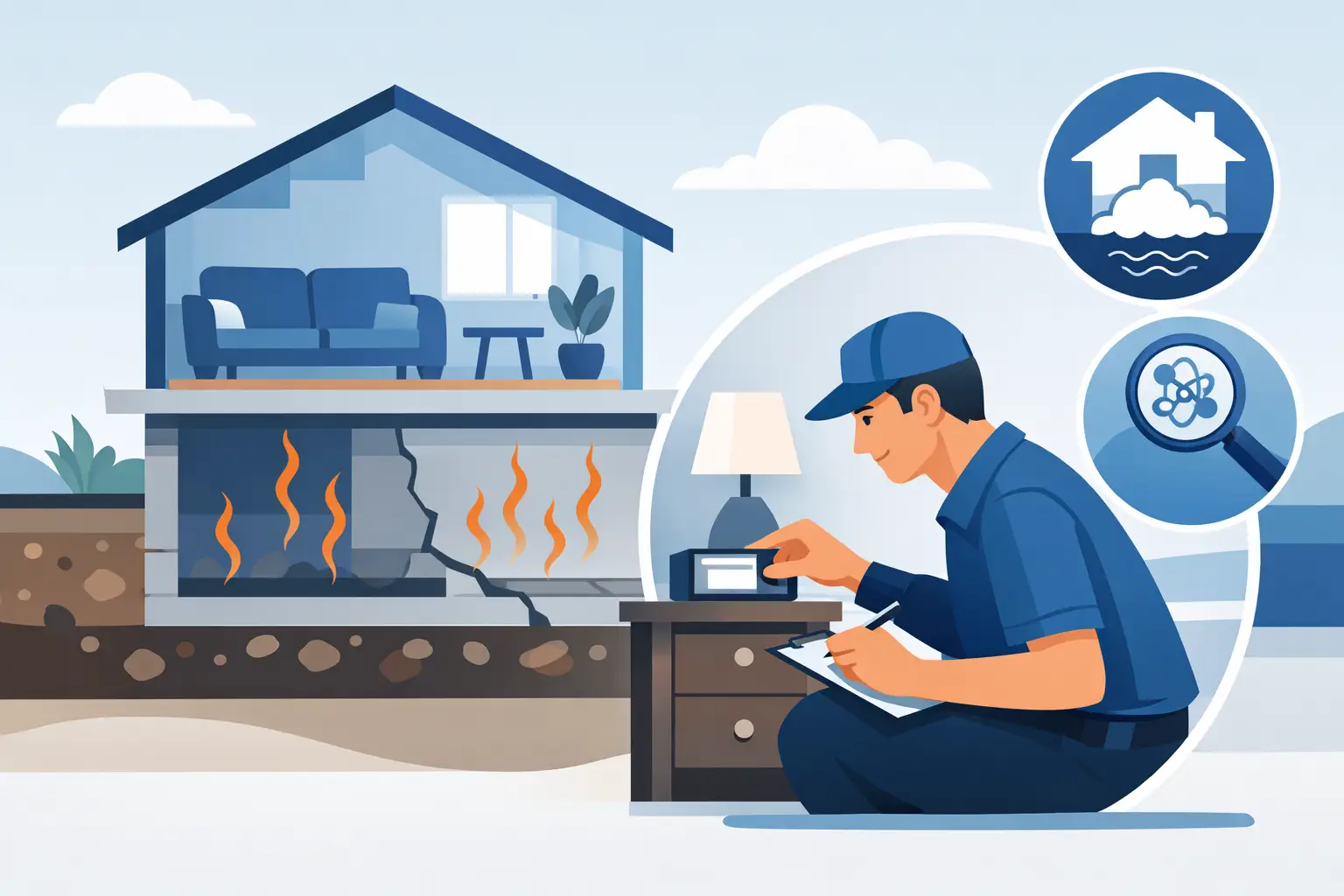
A home can look solid from the roofline to the foundation and still have a serious air-quality issue hiding in the lowest level. That is why homeowners and buyers regularly ask how to test indoor radon before they make a decision they cannot easily reverse. Radon is invisible, odorless, and naturally occurring, but exposure over time is a real health concern that should be measured, not guessed at.
For most people, the challenge is not understanding that radon matters. The challenge is knowing which test to use, where to place it, and how much confidence to put in the result. If you are buying, selling, maintaining a property, or approaching an 11-month warranty deadline, getting the test right matters because the next step depends on it.
How to Test Indoor Radon Without Guesswork
The first decision is whether you need a short-term test, a long-term test, or a professional inspection-grade measurement. Each has a place.
A short-term test is usually the fastest option. These tests often run from 2 to 7 days and are commonly used during real estate transactions because time is limited. They can tell you whether radon appears elevated right now, under controlled conditions. That makes them useful, but not perfect. Radon levels can change with weather, ventilation, season, and how the home is being used.
A long-term test runs for more than 90 days. It gives a better picture of the average radon level over time, which is often more meaningful for an occupied home. If you are not under contract pressure and want the clearest snapshot of day-to-day exposure, long-term testing is often the better choice.
Professional radon testing is typically the strongest option when accuracy, documentation, and procedure matter. This is especially true in a real estate transaction, in a commercial property, or when a previous result was borderline and you need clarity. A professional inspector follows placement rules, closed-house conditions, and reporting protocols that reduce the chance of a misleading result.
Choose the Right Radon Test for the Situation
If you are a homeowner checking your property as part of routine maintenance, a long-term test may make more sense than a quick kit. If you are buying a home and the inspection period is short, a short-term professional test is usually the practical choice. If you are an investor making fast decisions across multiple properties, consistency matters, and professional testing helps you compare properties on a more reliable basis.
There is also a difference between screening and decision-making. A do-it-yourself kit can be a reasonable screening tool. But if the result will affect negotiations, repairs, tenant safety planning, or post-mitigation verification, professional testing usually provides better support. In other words, the right test depends on what you plan to do with the result.
Where to Place a Radon Test
Placement is where many test results go wrong. Radon should be tested in the lowest livable area of the home. That means the lowest level that is actually used or could reasonably be used for living space. In many homes, that is the basement. In others, it may be the first floor if there is no basement.
The device should not be tucked into a corner, placed next to a window, set in a bathroom, or left near a draft, fan, or exterior door. It also should not sit in a kitchen, laundry room, or other area with excess humidity or unusual airflow unless the instructions specifically allow it. The goal is to measure normal indoor air in a representative area, not a distorted reading from a bad location.
A common rule is to place the test device at breathing height, away from direct sunlight, away from vents, and away from high-traffic interference. Professional inspectors know these placement standards and use them because a poorly placed device can create a false low or false high.
Closed-House Conditions Matter More Than Most People Realize
One of the biggest mistakes in radon testing is ignoring closed-house conditions. For many short-term tests, windows should remain closed and exterior doors should be kept shut except for normal entry and exit. These conditions usually begin at least 12 hours before the test starts and continue during the test period.
Why does this matter? Because open windows, whole-house fans, or unusual ventilation can dilute radon levels and make the result look safer than normal living conditions would suggest. On the other hand, testing during abnormal use of the home can also skew results in the other direction. The point is consistency. A test is only useful if it reflects controlled, standard conditions.
For occupied homes, this can take some planning. If a seller has a habit of airing out the basement every afternoon, that routine may need to stop for the test window. If a buyer is relying on the number to make a repair request, it is worth making sure the procedure is followed correctly.
How Long the Test Should Run
Short-term tests are quick, but shorter is not always better. A 48-hour test may be accepted in many real estate transactions, yet a slightly longer test period can sometimes provide more stable data. Long-term tests are better at smoothing out day-to-day swings, but they are not practical for every situation.
This is where context matters. If the property sale timeline only allows a short-term test, the key is to run it properly and interpret it within that limitation. If the result is close to the action level, follow-up testing may be a smart move rather than treating the first number as absolute.
Understanding the Results
In the United States, radon is commonly measured in picocuries per liter, written as pCi/L. The EPA action level is 4.0 pCi/L, meaning mitigation is generally recommended at or above that level. That does not mean lower levels are risk-free. It means 4.0 is the threshold where corrective action is strongly advised.
Results near the cutoff deserve careful handling. A reading of 3.8 is not the same as zero, and a reading just over 4.0 should not trigger panic. Radon risk is based on exposure over time, and test results can vary. That is why follow-up testing, especially after a borderline result, can be appropriate.
If a professional test reports elevated radon, the next step is usually mitigation, not repeated guesswork. A qualified mitigation contractor can design a system to reduce levels, and the home should then be retested to confirm the fix worked.
DIY Kit or Professional Radon Test?
A do-it-yourself kit can be cost-effective and useful for homeowners who are not in a rush. It can also be a reasonable first check for a property that has never been tested. But convenience comes with responsibility. The instructions have to be followed exactly, the timing has to be right, and the placement has to be correct.
Professional testing offers stronger control over the process. That matters for buyers, sellers, landlords, investors, and commercial property owners who need dependable results and clear documentation. It also removes the uncertainty that comes from wondering whether the test was placed correctly, disturbed during the test period, or shipped properly afterward.
For many clients, especially during a transaction, the value is not just the number. It is confidence in the number.
When to Retest a Home
Testing once does not mean testing forever. A home should be retested after radon mitigation, after significant foundation or ventilation changes, and at intervals that make sense for ongoing ownership. Finishing a basement, adding HVAC changes, sealing structural openings, or altering how the lower level is used can all affect radon behavior.
Retesting is also wise if an older result was taken under different living conditions or many years ago. Homes settle, systems change, and groundwater and soil conditions are not static. In Central Ohio, where geology can support elevated radon in some areas, routine caution is reasonable.
If you are buying, this is not a place to cut corners for speed. If you already own the home, this is not a place to rely on assumptions because everything feels fine. Radon does not announce itself, and that is exactly why proper testing matters.
Flinn Inspection Group approaches radon testing the same way it approaches every inspection service – with clear procedure, dependable reporting, and a commitment to helping clients protect the property decisions that matter most.
The best time to test is before uncertainty becomes a problem, because clean-looking space and safe air are not always the same thing.